
Description
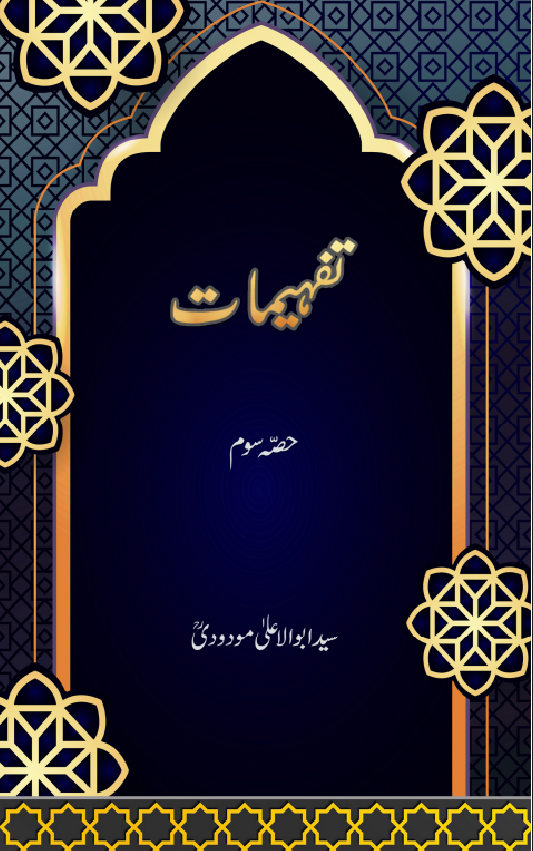
Tafhimat — Part Three (تفہیمات حصہ سوم) is the third installment of Syed Abul Ala Maududi’s celebrated essay series, bringing together some of his most intellectually rich and practically important writings on Islamic law, governance, wisdom, and history.
The volume is organized across four major sections. The first section focuses on Islamic legislation — examining the scope and limits of law-making in Islam, the concept of Ijtihad (independent legal reasoning), its doubts and critiques, the role of Shura (consultation) and Ijma (consensus), and the proper method for resolving disputes within an Islamic system. It also addresses the status of the Sunnah as a source of law.
The second section covers Hikmat-e-Deen (Wisdom of Religion) — exploring how Islam balances necessity and public interest (Maslaha) in its principles, the place of practical wisdom in religious life, and detailed rulings on Gheebat (backbiting) along with its spiritual and social implications.
The third section delves into Islamic laws and regulations, addressing sensitive contemporary questions such as the inheritance rights of adopted children, the response to the Family Laws Commission, the permissibility of meat slaughtered by People of the Book, fundamental human rights in Islam, and the positions of Imam Abu Hanifa on issues of Khilafat and rebellion.
The fourth section, Mutafarriqat (Miscellaneous), brings together broader reflections — the true purpose of the martyrdom of Imam Husain (رض), the cautionary decline of Western nations, and the correct methodology for Islamic movements across the world.
Rich in legal reasoning, historical depth, and moral clarity, this volume is indispensable for scholars, students of Islamic thought, and anyone seeking to understand how Islam addresses the complex realities of law, society, and civilization.